
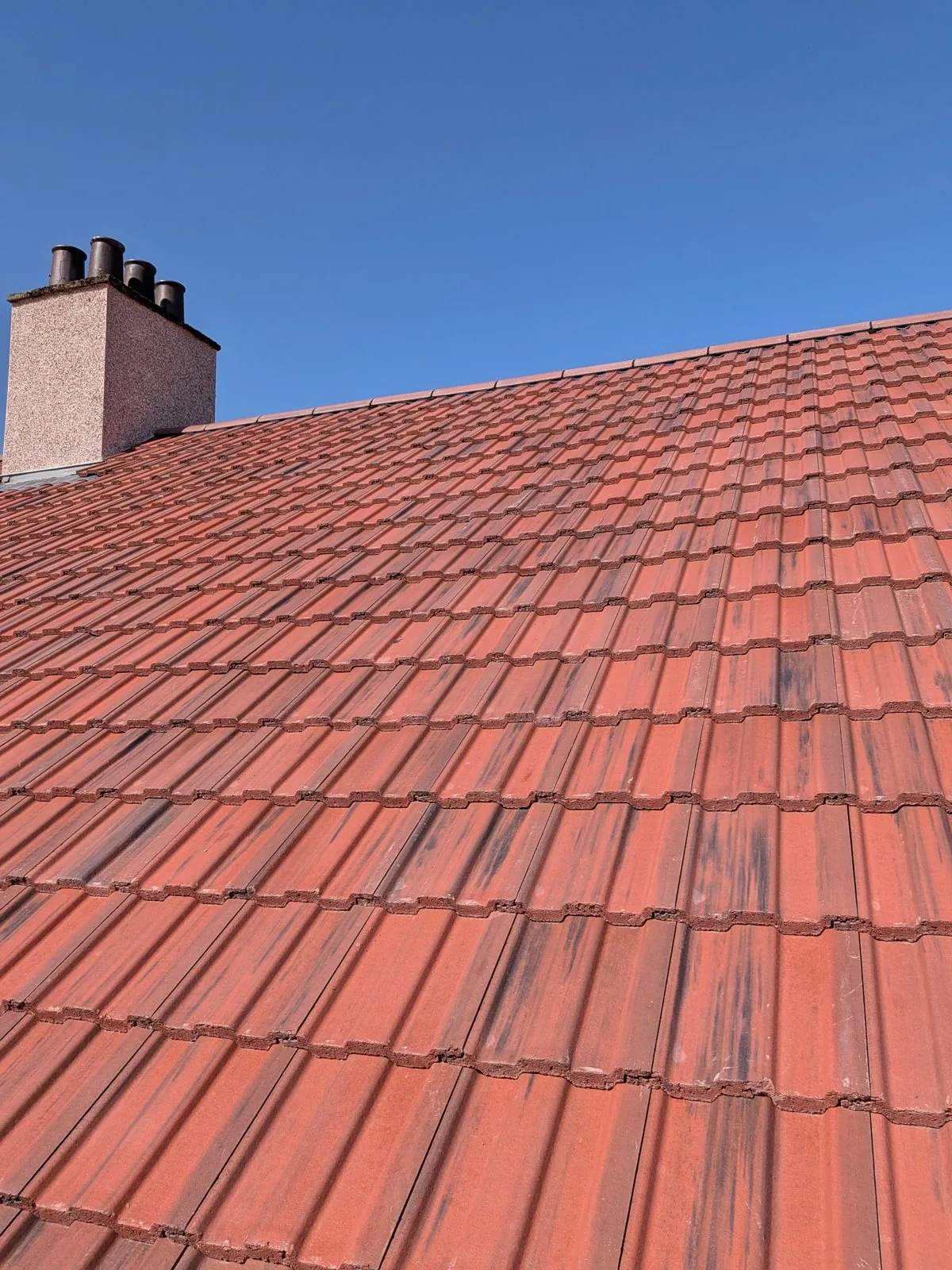
What ridge and hip tiles do
The ridge is the line along the very top of a pitched roof where two slopes meet. Hips are the sloping edges where slopes join on a hipped roof, common on bungalows and many semi-detached houses. Both are capped with rounded or angled tiles that close the joint and keep rain from running into it.
Because these tiles sit at the highest and most exposed points, they take more wind than any other part of the covering. When they work loose, rain is driven into the gap beneath and the timbers along the ridge stay damp for long periods.
Signs the bedding mortar has failed
On most older roofs, ridge and hip tiles are held only by a bed of mortar. Over the years, frost and movement in the roof crack that bedding and it slowly turns to powder. The tiles then rest loosely in place, held mainly by their own weight.
- Ridge tiles visibly out of line along the top of the roof
- Open gaps between tiles or under their edges
- Pieces of mortar in the gutters or on paths
- A tile that has already slipped or fallen
Rebedding in mortar
Rebedding means lifting the affected tiles, clearing away all the old, failed mortar and laying them again on a fresh, well-formed bed, with the joints between tiles pointed neatly. Undamaged tiles go back on; cracked ones are replaced.
Done properly, a rebedded ridge looks just like the original and keeps the traditional appearance some owners want, particularly on older houses where the neighbouring roofs are finished the same way.
The work should deal with the unstable length rather than leave loose sections beside a firm-looking patch. That boundary is checked while access is in place. Reusing sound tiles helps the finished ridge sit naturally with the roof, while replacing damaged pieces avoids bedding a known weakness back into the line.
Mechanical (dry) ridge fixing explained
The alternative is a mechanically fixed, or dry, ridge. Each tile is secured with clips and screws to a timber or metal fixing along the ridge, with a strip underneath that closes the joint while still letting the roof space ventilate. Nothing depends on mortar staying intact.
Dry fixing is well suited to exposed sites and to roofs where ridge tiles keep coming loose. Ridge and hip tiles rebedded or mechanically fixed is one of the regular jobs on the planned roof repairs list, and Richard will talk through which approach suits your roof.
Repointing versus full rebedding
It is tempting to run a line of new mortar along the outside of the joints and call it fixed. That only works if the bedding underneath is solid. Where it has crumbled, the new pointing simply sits on a loose base and cracks off again within a winter or two.
Before deciding, the tiles are checked by hand. If they are firm and only the surface has weathered, repointing is a fair repair. If they move, a full rebed or mechanical fix is the honest recommendation, and the price is explained before any work goes ahead.
Wind, frost and Scottish weather
Long wet spells followed by hard frost are what break down ridge mortar fastest, and autumn gales are when loose tiles finally come off. If a ridge tile has fallen, see emergency roof repairs for same-day help. For slipped slates further down the slope, the slate roof repairs page explains how those are refixed, and the wider roof repairs page covers everything else. If you are trying to trace a leak first, start with the leaking roof guide.
From the ground, compare the ridge after calm and windy weather. A fresh gap, a cap sitting at a different angle or mortar scattered below the eaves is enough reason to have it checked. Do not rely on an upstairs view alone: a tile can remain close to its original position after the bedding beneath has lost its grip.