The short answer
For most Scottish homes the best covering is the one the roof was designed to carry. Older sandstone tenements and villas were built for natural slate, while the majority of post-war and modern houses were built for concrete or clay tiles. Putting back the same type of covering keeps the weight, the look and the detailing in step with the rest of the building.
Changing from one to the other is possible in some cases, but it needs a reason and a check of the structure first. The sections below explain the trade-offs.
Natural slate on Scottish roofs
Slate is split stone, thin, dense and naturally resistant to water. It has been used on Scottish buildings for centuries, and on many Glasgow streets it is part of what gives a terrace or tenement its character. Traditional Scottish slating often uses slates of varying sizes laid in diminishing courses on timber sarking boards.
Laying slate is skilled, slow work, with each slate fixed individually and cut to suit hips, valleys and verges. The finish is thin, crisp and very long lasting when the material and fixings are good.
Concrete and clay tiles
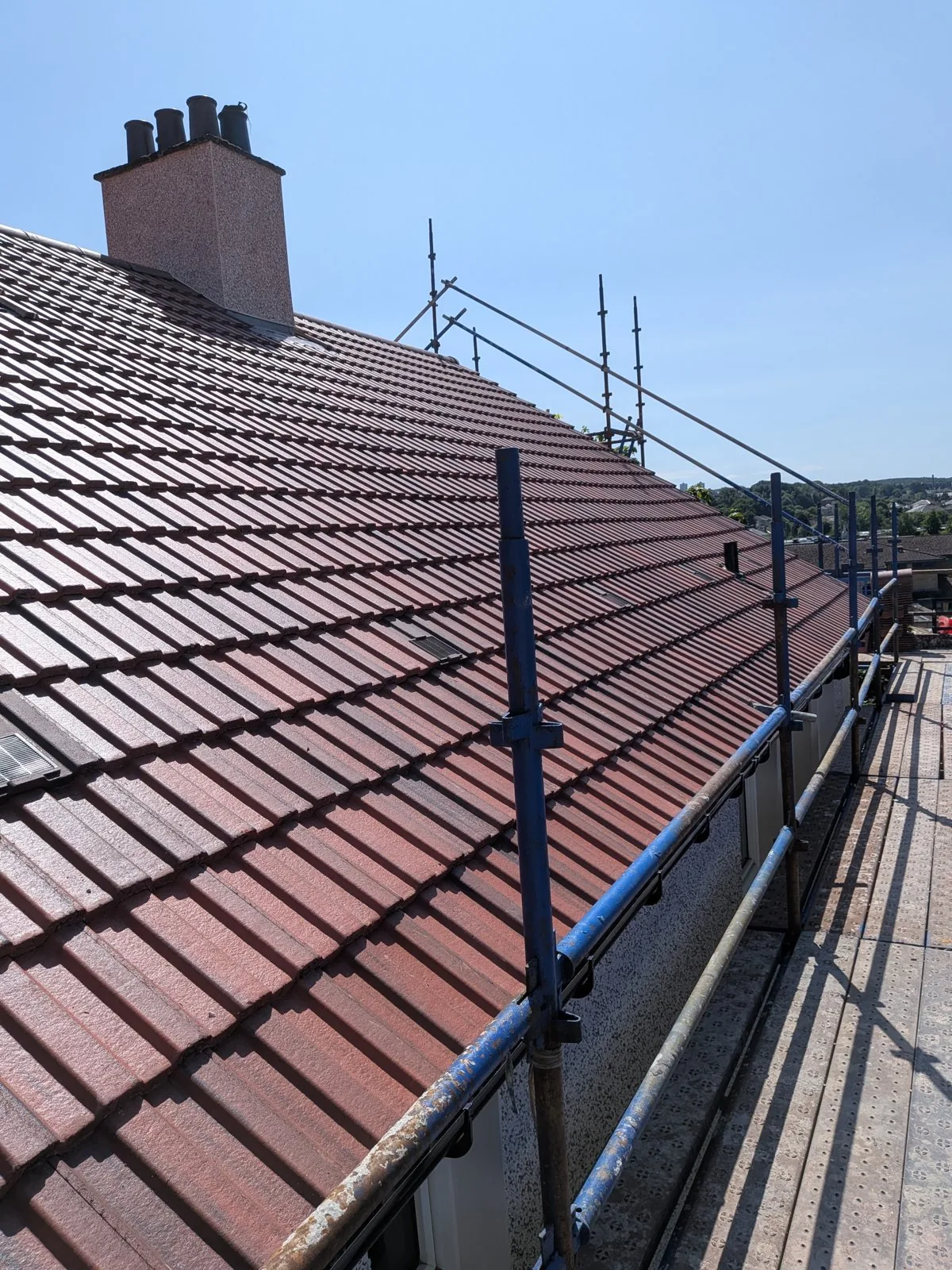
Concrete interlocking tiles are the most common covering on houses built in the second half of the twentieth century. They are larger than slates, quicker to lay and consistent in size. Clay tiles are less common in Scotland but appear on some properties and extensions.
Tiles hook over battens and interlock along their sides, which makes them straightforward to replace individually. Over many years their surface can weather and become more porous, and older tiles may be harder to match exactly.
Weight and roof timbers
Weight is the factor most people overlook. Roof timbers are sized for the load they were originally designed to carry. Concrete tiles are generally heavier per square metre than slate, so swapping a slate roof for concrete tiles can put extra strain on rafters and purlins that were never meant for it.
Going the other way, from tile to natural slate, is lighter on the structure but changes the batten layout, the detailing at the eaves and verges, and often the appearance of the street. Either change should start with a look at the timbers.
Lifespan and what actually fails first
On a slate roof, the stone frequently outlasts its iron nails, which is why slates start slipping long before the slate itself is worn out. Many of those roofs can be kept going with targeted slate roof repairs for some time. On a tiled roof, ridges, verges and the underlay tend to need attention before the tiles do.
Across both types, flashings, valleys and fixings are usually the weak points. When those are failing everywhere at once, a full re-roofing project is worth considering, and Richard will say honestly whether focused roof repairs still make sense.
Appearance, neighbours and planning
On a terrace or a row of semis, a roof that suddenly looks different stands out. In conservation areas and on listed buildings, the council may expect like-for-like materials, so it is worth checking with your local planning department before committing to a change of covering. Owners in shared tenements will also need to agree the choice together.
Colour is only part of the visual difference. Slate has a thin edge and tight courses, while interlocking tiles create a deeper, more regular profile. Verges, ridges and gutters may therefore look different after a change, even when the chosen colour is close to the neighbouring roof.
Cost drivers without the guesswork
Material choice is only one part of the bill. Roof size and pitch, scaffolding and access, the condition of the timbers, how many chimneys, valleys and dormers there are, and whether gutters and fascias are renewed at the same time all have a large effect. The new roof cost guide goes through those factors in more detail. Swift Roofing re-roofs tiled, slate and traditional roofs, and the price is explained before any work goes ahead.