
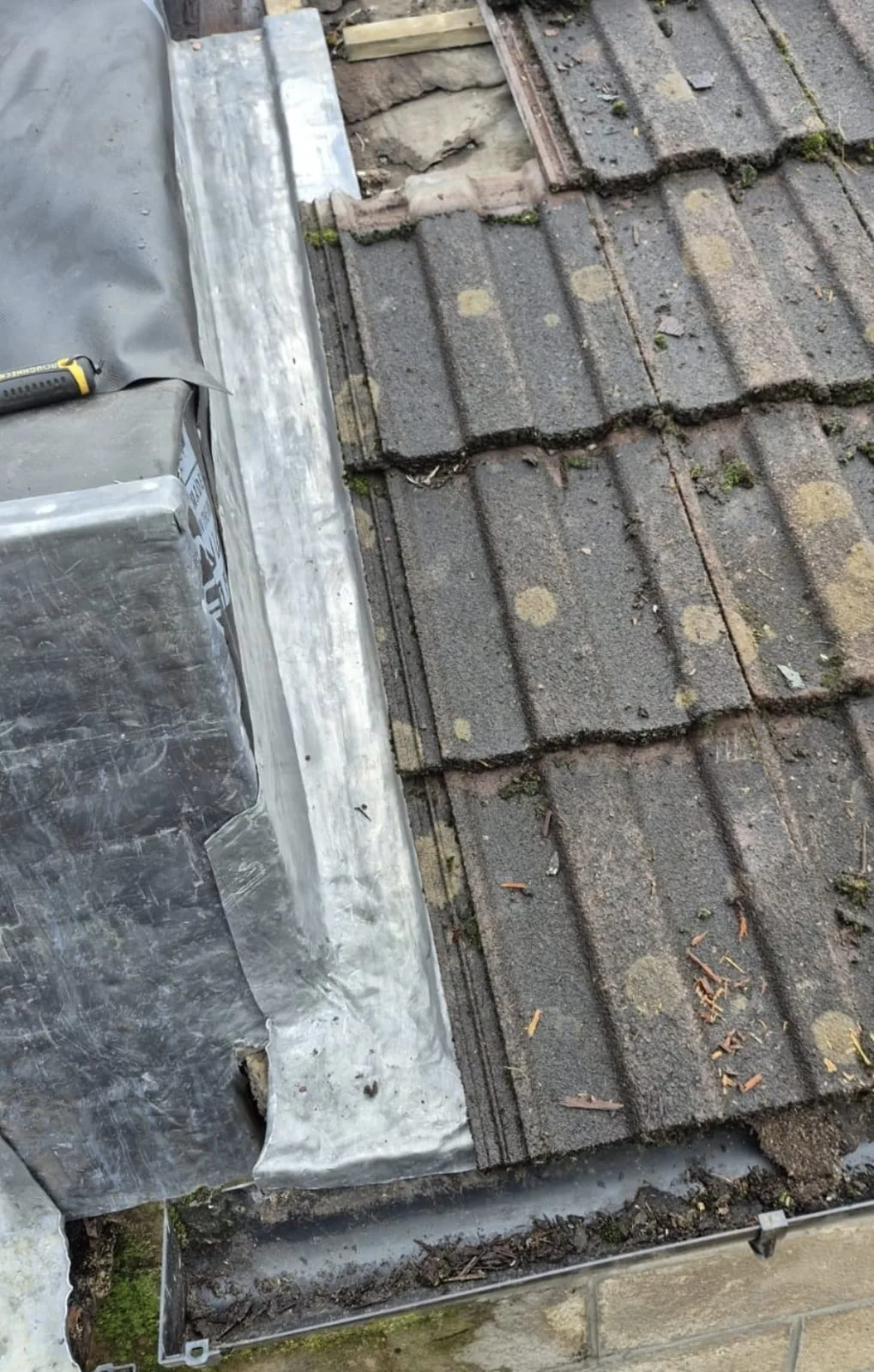
Where roofs meet walls, dormers and stacks
A slate or tile roof is very good at shedding water across its open slopes. The trouble starts wherever that surface is interrupted: against a gable or party wall, around a dormer window, at the sides of a chimney, or where an extension roof butts up to the main house.
At each of these junctions the roof covering cannot seal against the masonry on its own. A flashing, normally lead, is dressed over the gap so rain is guided back onto the roof rather than down behind it. When that flashing fails, water gets into the timbers and plaster, often some distance from where the stain finally appears.
Why mortar fillets crack and lead lasts longer
On many older Scottish houses, and on some cheaper repairs, the junction was finished with a fillet of sand and cement instead of lead. It looks neat for a while, but a roof and a wall move slightly differently as they heat, cool, dry and get soaked. Rigid mortar cannot follow that movement, so it cracks and pulls away.
Lead is soft and flexible. Dressed correctly and fixed into the wall joints, it accommodates that movement for many years. That is why cracked fillets are replaced with properly dressed lead rather than another layer of mortar.
Split or lifted lead: repair or renew
Lead fails in a few predictable ways. Long pieces with too few joints split as they expand and contract. Wedges holding it into the brickwork work loose and the top edge peels out. Wind lifts poorly fixed lead until rain can blow underneath.
Where the damage is local and the rest of the flashing is sound, the faulty section is dealt with on its own. Where the lead is thin, badly fitted or failing along its length, renewing the flashing at walls, dormers or chimneys is the lasting fix. The photo at the top of this page shows new lead being dressed at exactly this kind of junction.
Valley gutters: clearing, repairing and relining
Valleys collect the run-off from two slopes and channel it down to the gutter, so they carry more water than any other part of the roof. Moss, leaves and broken pieces of slate gather in them, and once the channel is blocked, water spills sideways under the covering.
Some valleys only need clearing. Others have worn or cracked linings that need repairing. Where the lining has reached the end of its life, the valley is relined so it can carry water freely again. All three are part of the everyday repair work Swift Roofing carries out.
A stain below a valley does not reveal by itself whether the lining has failed or the channel has simply been overwhelmed. The surrounding slates or tiles, the outlet at the bottom and any debris trapped along the run all need checking. Dealing with the obstruction while missing a damaged lining, or renewing sound material without clearing the drainage path, would leave the real cause in place.
Finding the true source of a leak
Water can travel along a rafter, a batten or the top of a ceiling before it shows itself, so the damp patch is often not directly below the fault. Checking flashings, valleys and abutments in turn is how the real cause is found. The leaking roof guide explains what to note before calling.
The timing of the leak is useful evidence. Water that appears only when rain is driven from one direction can indicate a lifted edge or open joint, while staining that worsens whenever a valley carries heavy flow points somewhere else. Sharing those details helps focus the inspection, although the roof still needs to be seen before a repair is agreed.
Chimney-specific work such as repointing and flaunching is covered on the chimney repairs page, and junctions where a flat roof meets a wall are dealt with as part of flat roofing work. For everything else, see the main roof repairs page. Swift Roofing carries public liability insurance and explains the price before any work goes ahead.